
Tag Archive for: Leadership

26.11.2021

The current time requires constantly to deal with challenges and to deal with change. There are many forms of facing these topics. Most of these formats are very rational. With 3D mapping, a completely different approach is practiced: in a creative and intuitive way, approaches to solutions are found and developed. Creating the future with the help of 3D Mapping.

And what exactly is 3D mapping?

An organizational development method created by the Presencing Institute and used primarily by teams dealing with change and challenges. 3D Mapping provides the ability to visually map a system or issue or idea and look at how it might evolve from multiple dimensions and perspectives.

The strength of this method lies in the fact that participants think out of their heads, work with their hands and create a model together. One does not think about the current situation and its possible development.

In a creative and intuitive development process the image of “reality” is created. If the knowledge of one’s own hands is trusted, one does not fall back into habitual ways of thinking about the present and imagine the future as a continuation of the existing, but it is very likely that new ways will be discovered. And that is exactly what creating the future with the help of 3D mapping is.

Creative techniques are used and different creative materials are employed. At first glance, it looks a bit like a DIY session, but it is an innovative method that has long since gained recognition in the business world. At the latest after Design Thinking has conquered the stage.

3D Mapping in 3 steps

Before ideally 4-7 participants start creating the model of their system or their issue, it is made clear what the intention is and what the focus of the mapping is.

The first step is then to create a mapping that represents the current state of a system. Each object in the model represents a different element, quality or stakeholder of the system.

In the second step, team participants reflect on the model from four different perspectives and with different questions. This gives the participants the opportunity to each develop a different view of the existing system from a different archetypal perspective.

In the third step, the participants design the future based on the insights gained. To do this, they change the model in such a way that it better represents the new future they want to bring into the world.

Afterwards, the overall process is reflected upon and measures can be derived to solve or redesign the problem. As a rule, these measures are characterized by the fact that they get to the point and prioritize themselves immediately. In addition, there is no need to call in a committee of implementers. This has already been done in the process.
That’s probably why this method is so powerful. It is sustainable.

An example: 3D mapping in a nursing facility

A few weeks ago, we implemented this process of 3D mapping with the care management team of a nursing facility. It was incredible to see the emotions that immediately come into play when this format is used. We experienced emotionally heavy moments, but also very touching ones.

The members of the team got into a good flow very quickly when creating the model and, without consulting each other, created the current situation in an intuitive and creative way.

For us as process facilitators it was nice to observe how the people in this team trusted each other, worked together and protected and supported each other. Thus, there was a necessary stability to create what emerged.

The process starts with an AS IS picture

When the work began, the energy in the room changed noticeably, it became visibly heavy and oppressive. This energy was also reflected in the model: Although the good unity of the team members was evident here as well, heaviness and chaos dominated in many places. Many walls, demarcations, no cooperation. On the contrary, in many areas there was a recognizable counteraction and watching each other.

When the team members reflected on the model, everyone was quickly aware that a change had to be made promptly. One statement was “if you look at the model longer, you would like to run away”. This statement sums up the image and energy in the room well. However, there were also statements of encouragement. In reference to the leadership team, the terms “love” and “our unity” fell; in reference to the nursing facility, the potential and spirit of the home was emphasized.

After creating the current situation and reflecting on the model, the leadership team was mentally and physically exhausted. This was a completely normal process, as they had been very intensively involved in this process. We paused here in the process and did not design the future model until two more weeks had passed. This allowed the team members to reflect on the process again in peace, to gain some distance and to shape the future with fresh energy.
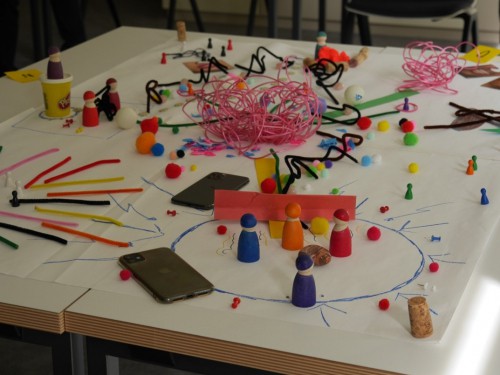
3D Mapping process

The second step is about future

At the beginning of the second session, experiences and insights from the first session were reflected upon once again. Afterwards, the team members set about designing the future with great enthusiasm.

Very quickly they were back in the flow. And without any consultation, one change after the other was made to the model. What a difference it was from the last time!

A lot of lightness unfolded in the room. A very light energy and love were noticeable, the true spirit of the house spread. There was nothing of the leaden heaviness of the last time, which also affected the team members. The team energized and motivated. And for all to see the weight that had fallen from the shoulders of the team members and how a breath of fresh air could take place. That was constructive and effective future design with 3D mapping.

The presented future shows a picture of understanding and togetherness. Looking at the model, the team members were able to quickly develop initial ideas on how to achieve this future. They are very optimistic and motivated to create this ideal image together – with the nursing staff – and to make the house a unique place for the residents and relatives.
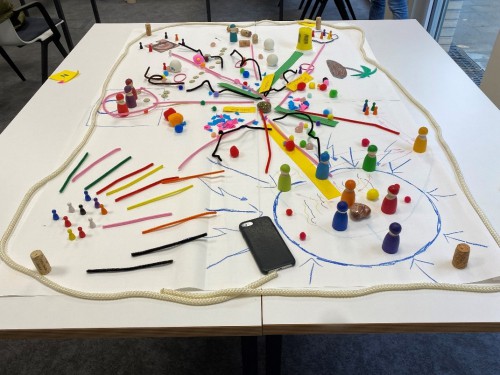
3D Mapping process

3D Mapping process

For us, it was a fulfilling task to be able to support the nursing management team in finding a way to shape the future and we are also pleased to be able to accompany them for a while.


Want to know more about 3D mapping process?

Please contact us.

This case was written by Julia Winkler.

15.04.2021

Today, human “work” is increasingly migrating to the machine and AI is taking over more and more tasks from us. By doing so, it is only driving forward a process that has already begun. Many of the classic “jobs” have been the responsibility of the so-called “low-wage countries” for years. How contemporary is the term “co-worker” – at least in industrialized countries? Is there a change on the horizon?
The one “from co-worker to co-creator”?
(By the way: we always think diversely, even if we “sacrifice” the wording for the sake of reader-friendliness).

Work has a lousy image

In the ant-song from Tabaluga you can hear “Work is half of life …”. And indeed, there were times when a large part of the population of the industrialized countries would have fully agreed with this. And still today we encounter this confirmation from other regions of the world.

Although the term “work” is initially described neutrally as a “purposeful, social, planned and conscious, physical and mental activity”, it nevertheless has a “hidden agenda” attached to it. Work is usually associated with burden and effort, with complaint, and often with “unfair” working conditions. This attribution has its roots in ancient medieval times. And although the Christian, primarily Protestant religion has tried to give work a positive “image” and this was also emphasized again and again in the course of industrialization, it remained so – we still associate with work a matter of the socially lower classes.
It is poorly paid and performed by people with low education. These people supposedly need representatives who enforce their interests and leadership, since they cannot lead themselves.

Perhaps sociology could provide a remedy here. According to its definition, work is a process in which people enter into social relationships that are of central importance in the overall context of life; these include the structuring of time, social recognition and self-esteem.
And, honestly, that was a great try, but who would define “work” that way?

Co-worker, employee, colleague, ….

When it became clear that trying to correct this “hidden agenda” with optical polishes was not really fixing the problem, new names were created for the more modern or educated worker: Co-worker or Colleague and “Senior Associate” or “Executive.” In this way, they distanced themselves from the lower class, which, for example, also had hierarchical levels in the form of the foreman, and created a parallel world. With the familiar social conflicts. And then – for whatever reason – a compromise was reached in the world of Management 2.0+. All of them became the species “co-worker”. Employees of a company who are assigned to a manager. So much hierarchy was necessary after all. Although there is also an ambiguity, because managers are also employees and therefore actually co-workers.
To top it off, all of them are “workers”. Again, “work”. And whatever it actually means.

In any case, it sticks with the “worker”. With the whole worker story in the luggage. With or without a crown. More or less dependent.

Expiration of the term the “co-worker”

That somehow no longer fits the times, does it?
The term “work” is overdue now, at least in the age of the next big digital transformation. Even if it is still a central component of our understanding of the economy, primarily the national economy, which is still valid and characterized by performance thinking.

How unsexy it is today to see oneself as a “worker”. Who among us still wants to “work”?
The term “co-worker” has had its day; it simply no longer has any appeal or hardly any appeal.
At least the “work(er)” part is then best left for disposal. But what happens to the ” co-“?

From co-worker to co-creator
What exactly “co-” is and what does it mean? First of all, “co-“ means “with” or “also” and not “alone”. “Co-” requires others in each case. That is the spirit of the times. Today, we still talk a lot about teams, but now the idea of collaboration is gaining ground. The idea of creating something together. As opposed to every man for himself. By the way, collaboration has its roots in working together with the “enemy”. That really resonates with a lot of transformation potential.

Co-creation is therefore the current and forward-looking approach. There the “co-” is further in it. And something new. This is “creating” instead of “working”.

For some time now, a re-prioritization can be seen in people’s basic motivations. It is no longer the motivation to perform that is most pronounced, but rather that of influencing or shaping and that of connecting. In some sources, the basic motives are supplemented today by “freedom,” the motive that is currently becoming a shooting star. And “influence” as well as “freedom” have little to do with what we conventionally understand by “work”.

It really looks like the shift is coming: from co-worker to co-creator.

Spot on the “co-creator”

Assuming that the co-creator does exist, what distinguishes him from the “co-worker”?

First of all, a completely new basic understanding and a changed attitude. Designing or influencing something oneself does not mean waiting for a task to be assigned. It means becoming active, perhaps even proactive, and getting involved proactively. It is about ownership.

Energy that may be tied up in resistance in the “co-worker” is released in the “co-creator”. Creative potential and joy in self-efficacy can emerge.
What a benefit for the individual and the entire company.

At the same time, the requirements increase. It is important to deal with what one’s own contribution is, where one’s personal strengths lie and can be developed. Attentiveness and care for oneself and visibility in business take on a special significance. Courage is required to defend one’s own point of view. And resilience, should this not prevail with other co-creators. This can also be quite strenuous and takes those affected out of their comfort zone.

These are all future competencies that sometimes need to be developed first. An accompanying qualification offensive is certainly indispensable here.

Effects in the system

However, moving from ” co-worker to co-creator” is not done by changing the attitude and behavior of the “co-creator”.
It has an impact on the entire system and culture of an organization or company.

Co-creators have something to contribute and say, and they want to be heard. For this, it is necessary to create a suitable framework, formulate governance and develop principles of collaboration.

Co-creators have different requirements for their environment in terms of the type and location of the place where value is created. Here, a flexibilization of existing structures would be required. Mobile work and trust instead of control of times would be basic requirements. As would an understanding of which formats are suitable for joint creation and exchange.
Here, at the latest, we are in the center of the transformation to the “New Work” which is taking place anyway.

Leaders First

The shift from co-worker to co-creator can only be considered if leaders internalize and support the shift.
In fact, such an approach requires executives to be engaged in the transition even before implementation.

Co-creators, who take ownership, contribute themselves effectively and thus take over leadership through their role, make classic leadership unnecessary. New and future-oriented competencies are then also and especially required of leaders.

First, however, we need a mindset shift and the development of a supportive attitude in management and among all decision-makers. The following also applies to executives: From co-worker to co-creator.
This journey should be accompanied and begin before the “co-workers” set out on their journey.

Interested in going deeper? Gladly.
Please contact us.

You create the future.
This is something we’re good at.